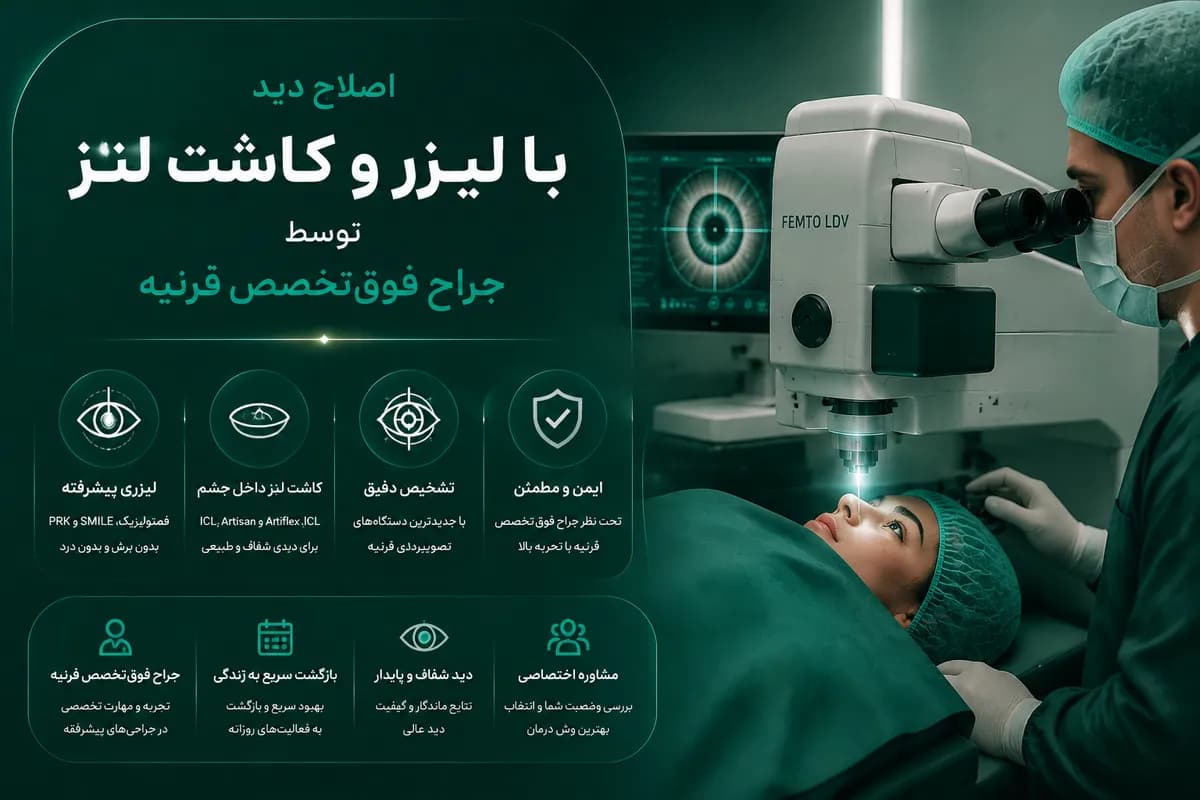
Laser Vision Correction and Lens Implantation by Cornea Specialist Surgeon
Laser vision correction and lens implantation are advanced methods to improve eyesight without the need for glasses or contact lenses. These surgeries are performed by cornea specialist surgeons using modern technologies and can effectively treat conditions like myopia, hyperopia, and astigmatism.
Vision Correction with Laser Surgery and Intraocular Lens Implantation by a Corneal Specialist
Introduction
Achieving clear vision with less dependence on glasses or contact lenses is one of the main goals for many people with vision problems such as myopia, hyperopia, and astigmatism. Today, advances in ophthalmic technology have made several vision correction options available, allowing treatment to be selected according to each patient’s individual eye condition.
Techniques such as laser vision correction, Femto-LASIK, PRK, SMILE, and intraocular lens implantation are among the advanced methods used to correct refractive errors. These procedures are selected after a detailed eye examination and are performed by a corneal specialist.
What Is Laser Vision Correction?
Laser vision correction refers to a group of advanced procedures that precisely reshape the cornea in order to improve the way light enters the eye and focuses on the retina.
In people with refractive errors, light does not focus properly on the retina, resulting in blurred vision. By adjusting the curvature of the cornea, laser treatment can improve light focusing and reduce dependence on glasses.
Which Vision Problems Can Be Corrected with Laser Surgery?
Laser procedures are commonly used to correct:
Myopia
Hyperopia
Astigmatism
Certain combined refractive errors
However, these procedures are not suitable for everyone, and a detailed eye evaluation is necessary before treatment.
Types of Laser Vision Correction Procedures
Femto-LASIK
Femto-LASIK is one of the most advanced methods for correcting refractive errors and is performed using both a femtosecond laser and an excimer laser.
In this procedure, a very thin corneal flap is created. The corneal tissue is then precisely reshaped with the laser, after which the flap is repositioned.
Benefits of Femto-LASIK:
High precision in vision correction
Rapid visual recovery
Less pain and discomfort after surgery
Suitable for many people with myopia and astigmatism
PRK
PRK is an older but still effective method of vision correction in which the outer surface of the cornea is reshaped without creating a corneal flap.
This procedure may be a suitable option for some patients with thinner corneas or specific eye conditions.
Benefits of PRK:
Greater preservation of corneal structure
Suitable for some patients with thinner corneas
Stable results in refractive error correction
SMILE
SMILE is a modern laser vision correction technique performed through a very small incision in the cornea.
In this procedure, a small piece of corneal tissue responsible for the refractive error is removed.
Features of SMILE:
Minimal disruption to corneal tissue
Lower risk of dry eye in some patients
Faster recovery compared with some traditional procedures
Suitable for many people with myopia
Intraocular Lens Implantation for Vision Correction
Intraocular lens implantation is another advanced method of vision correction that can reduce dependence on glasses without reshaping the cornea.
This approach is generally suitable for people who:
Have a high eye prescription
Do not have sufficient corneal thickness for laser surgery
Experience severe dry eye
Are not suitable candidates for laser vision correction
Types of Vision Correction Lenses
ICL
The ICL is one of the most commonly used intraocular lenses and is placed between the iris and the eye’s natural lens.
Features include:
Preservation of the eye’s natural structure
Suitable for high levels of myopia
Excellent visual quality
Possibility of lens removal in certain situations
Artisan and Artiflex Lenses
These lenses are positioned in the front part of the eye and are used to correct certain refractive errors, particularly moderate to severe myopia.
The choice of lens depends on the structure of the eye, the degree of refractive error, and the specialist surgeon’s evaluation.
Why Is It Important to Have These Procedures Performed by a Corneal Specialist?
The cornea plays a major role in focusing light and determining visual quality, and even small changes in its structure can affect the outcome of treatment.
A corneal specialist carefully evaluates factors such as:
Corneal thickness and shape
Ocular surface health
Degree of dry eye
Condition of the retina and lens
Based on these findings, the most appropriate vision correction method can be selected for each patient.
Examinations Required Before Vision Correction
Before any type of vision correction surgery, a complete eye examination is performed, which may include:
Corneal topography and tomography
Measurement of corneal thickness
Eye pressure assessment
Evaluation of overall eye health
Accurate measurement of the eye prescription
These examinations help reduce the risk of complications and make surgical outcomes more predictable.
Conclusion
Today, laser vision correction and intraocular lens implantation are among the most advanced methods used to treat refractive errors. Selecting the appropriate procedure requires a detailed and specialized evaluation of each patient’s eyes.
With modern technologies and the experience of a corneal specialist, many people can achieve clearer vision, reduce their dependence on glasses, and improve their overall quality of life.
please Login to leave a comment
Add Your Comment
Reviews