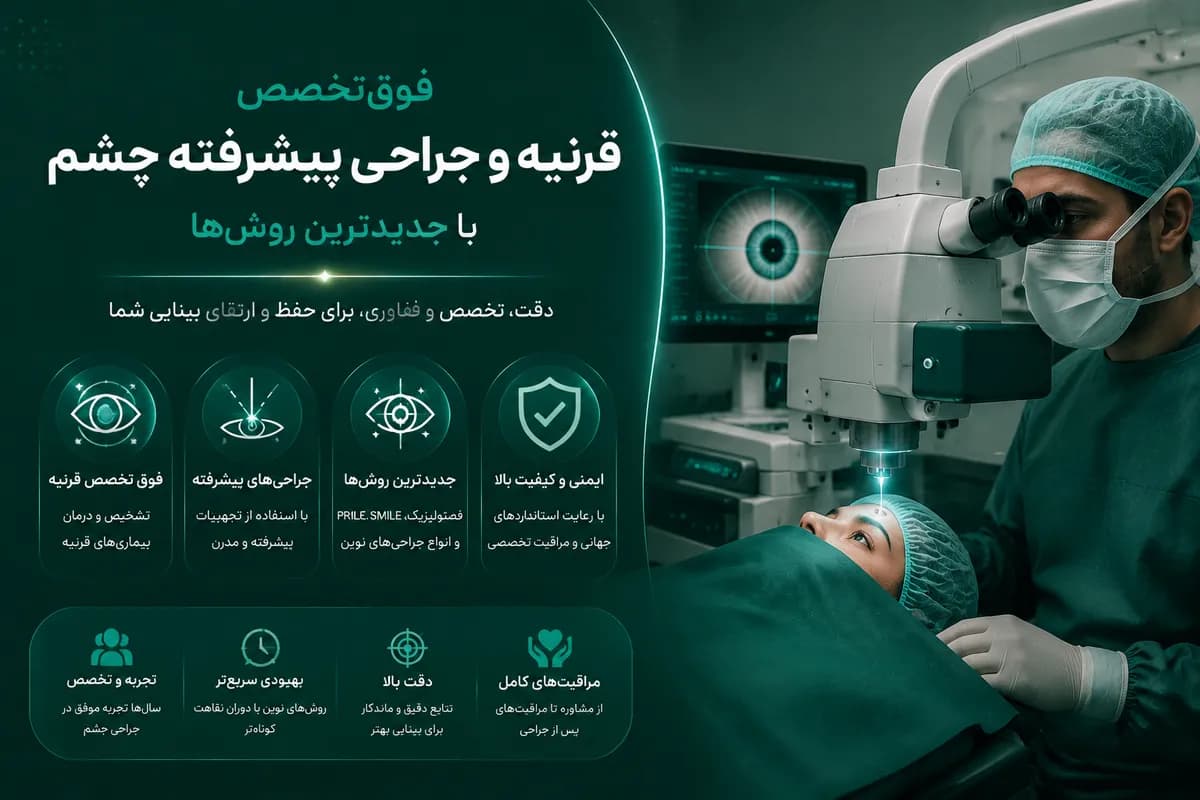
Cornea Specialist & Advanced Eye Surgery with the Latest Techniques
Advanced eye surgeries using modern technologies have made it possible to effectively treat corneal diseases and improve vision. This article explores procedures such as Femto-LASIK, SMILE, PRK, and corneal transplants performed by cornea specialists.
Corneal Specialist and Advanced Eye Surgery Using the Latest Techniques
Introduction
The cornea is one of the most important parts of the eye and plays a major role in transmitting and focusing light to create clear vision. Any damage, deformation, or disease affecting the cornea can have a direct impact on visual quality.
With advances in ophthalmology, it is now possible to treat corneal diseases and complex vision problems using modern techniques, precise diagnostic equipment, and advanced surgical methods. A corneal specialist and advanced eye surgeon uses the latest technologies to diagnose, treat, and manage a wide range of corneal diseases and refractive errors.
What Role Does the Cornea Play in Vision?
The cornea is the transparent, dome-shaped layer at the front of the eye and is the first structure through which light enters the eye. By refracting light, it helps form a clear image on the retina.
A healthy cornea is essential for clear vision. Problems such as thinning, deformation, inflammation, or corneal opacity can lead to reduced vision.
Common Corneal Diseases
A corneal specialist plays an important role in diagnosing and treating various corneal conditions, including:
Keratoconus
Corneal opacities
Corneal infections and inflammation
Severe dry eye and ocular surface diseases
Damage caused by trauma or previous surgeries
Problems caused by irregularities of the corneal surface
Accurate diagnosis and timely treatment can help prevent further vision loss.
Modern Methods for Diagnosing Corneal Diseases
Today, corneal diseases are not diagnosed through a simple eye examination alone. Advanced technologies are used to evaluate the structure of the eye in detail.
Some modern diagnostic methods include:
Corneal Topography
This technique creates a detailed map of the corneal surface and is used to diagnose conditions such as keratoconus and to evaluate the cornea before vision correction surgery.
Corneal Tomography
This technology provides a highly detailed assessment of corneal thickness, curvature, and the structure of different corneal layers.
Ocular Surface Evaluation
Assessing tear quality, dry eye, and the health of the tear film helps determine the most appropriate treatment.
Advanced Corneal Surgeries
Corneal Cross-Linking
Corneal cross-linking is one of the most important treatments used to control keratoconus. It strengthens corneal tissue and helps prevent further progression of corneal deformation.
In this procedure, riboflavin and controlled ultraviolet light are used to strengthen the collagen bonds within the cornea.
Corneal Transplantation
In cases where the cornea is severely damaged or has an opacity that cannot be corrected, corneal transplantation may be performed to restore transparency and improve vision.
Modern corneal transplant techniques include:
Full-thickness corneal transplantation (PKP)
Deep anterior lamellar keratoplasty (DALK)
Endothelial keratoplasty (DMEK and DSAEK)
These techniques have made more precise treatment and faster recovery possible in many cases.
Refractive Surgery
One of the major areas of corneal subspecialty care is the correction of vision problems such as myopia, hyperopia, and astigmatism.
Modern vision correction methods include:
Femto-LASIK
A precise laser-based technique used to reshape the cornea and reduce dependence on glasses.
PRK
A suitable option for some patients with specific corneal conditions. It is performed without creating a corneal flap.
SMILE
An advanced technique that uses a very small corneal incision and can be used to correct certain refractive errors.
Intraocular Lens Implantation
For some patients who are not suitable candidates for laser eye surgery, intraocular lens implantation may be an appropriate option.
These lenses include:
ICL
Artisan
Artiflex
By correcting the way light is focused inside the eye, these lenses can help improve vision and reduce dependence on glasses.
Modern Treatments for Ocular Surface Diseases
Ocular surface conditions such as severe dry eye, inflammation, and tear gland dysfunction also require specialized treatment.
Today, modern diagnostic and treatment methods can help:
Improve tear film quality
Control ocular surface inflammation
Reduce dry eye symptoms
Maintain corneal health
Why Is It Important to See a Corneal Specialist?
Corneal diseases and advanced eye surgeries require specialized knowledge, surgical experience, and precise diagnostic equipment.
A corneal specialist carefully evaluates the condition of the eye and selects the most appropriate treatment method to achieve a safe and suitable outcome for the patient.
Factors that may influence treatment selection include:
Patient age
Corneal thickness and health
Severity of the condition
Visual status
Ocular surface condition
Conclusion
Advances in ophthalmic technology have made it possible to treat many complex corneal diseases and vision problems with more precise and lower-risk techniques.
From treating keratoconus with corneal cross-linking and correcting vision with laser surgery to implanting intraocular lenses and performing advanced corneal transplants, patients today can benefit from the expertise of a corneal specialist and modern technologies to help preserve and improve their vision.
please Login to leave a comment
Add Your Comment
Reviews